

Most drivers want the same things from their vehicles: fewer surprises, fewer expensive repairs and as many reliable miles as possible.
The good news is that you don’t have to be a car expert to take better care of your vehicle. CarMD asked its team of experienced, ASE-certified Master Technicians about the car-care mistakes they most wished drivers would avoid.
One theme came through clearly: being proactive about vehicle maintenance can help prevent problems from becoming more serious and expensive.
Here are some of their top reminders for keeping your vehicle healthier for the long haul.
1. Don’t Put Off Recommended Maintenance
The most common damaging decision identified by CarMD’s technicians wasn’t one particular broken component. It was neglecting or postponing recommended maintenance.
It’s easy to put maintenance off when the car still starts and nothing seems wrong. But waiting until a maintenance need becomes an obvious problem can mean missing the opportunity to address it earlier.
One technician summed it up simply: “Lack of maintenance usually costs more than preventing it.”
Start with the maintenance schedule for your specific vehicle. As another technician advised: “Read your owner’s manual. Follow it.”
Maintenance needs vary by vehicle, so follow the recommendations for your specific year, make and model rather than relying solely on a universal mileage rule.
2. Make Oil Changes a Priority
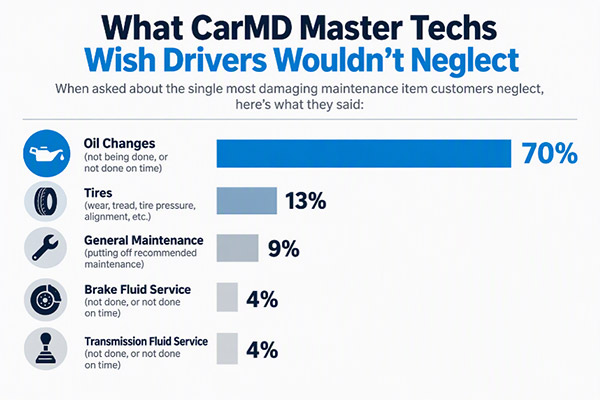
When CarMD asked its technicians to identify the single maintenance item they most wished drivers would stop neglecting, 70% chose oil changes that weren’t being done or weren’t being done on time.
Oil plays a critical role in protecting and lubricating engine components, so letting oil maintenance slide can contribute to engine problems. But there’s no single oil-change interval that works for every vehicle. Follow the oil specifications and service intervals recommended for your car and driving conditions.
And remember that an oil change is only one part of vehicle maintenance. As one technician put it:
“Just changing the oil/filter is not maintaining your vehicle.”
3. Pay Attention to Your Tires
Tires were another maintenance area CarMD technicians wished drivers would pay more attention to, including tire wear, tread, pressure and alignment.
Because tires can lose pressure and wear gradually, problems aren’t always immediately obvious from behind the wheel. Make tire checks part of your regular vehicle-care routine. Look for unusual wear or damage, check tire pressure regularly and pay attention to changes in how your vehicle handles.
For the proper tire pressure, use the tire-information placard on your vehicle or check your owner’s manual rather than relying on the maximum pressure printed on the tire.
4. Don’t Ignore Dashboard Warning Lights
Ignoring the check engine light was another damaging driver decision identified by CarMD’s technicians.
A dashboard warning light is information from your vehicle. It doesn’t automatically mean a major repair is coming, but it does mean your vehicle has detected something that deserves attention.
Finding out why the light is on gives you an opportunity to understand the problem and decide what to do next before it potentially becomes more serious.
Check engine light on? Read What Does Your Car’s Check Engine Light Really Check?
Check engine light flashing? Read Have You Ever Been Flashed? By a Check Engine Light, That Is.
5. Remember That Your Car Has More Fluids Than Oil
Oil gets a lot of attention, but CarMD technicians also pointed to coolant, brake fluid, transmission fluid and other vehicle fluids as maintenance areas drivers sometimes neglect.
One technician offered a memorable reminder: “Changing fluids is cheap insurance for your vehicle.”
How and when those fluids need attention varies by vehicle. Check your manufacturer’s recommendations rather than assuming every vehicle requires the same services at the same intervals.
6. Be Proactive Instead of Reactive
One of the broader mistakes technicians identified was being reactive instead of proactive about maintenance and repairs.
Being proactive doesn’t mean replacing things that don’t need to be replaced or worrying about every new sound. It means knowing what your vehicle needs, staying reasonably current on maintenance and paying attention when something changes.
One technician put it especially well: “Care for your vehicle’s health the same as you would for your own health.”
A little preventive attention can help you identify potential problems before your car forces you to deal with them.
7. Use Online Car Advice Wisely
Drivers have more automotive information at their fingertips than ever, but information and diagnosis aren’t always the same thing.
One CarMD technician offered advice that’s especially relevant today: “The Internet is full of information, but unless it comes from a reputable source, it may be misapplied.”
A symptom, warning light or diagnostic trouble code can be a useful starting point, but it doesn’t necessarily identify the exact component that needs to be replaced. Look for credible information specific to your vehicle and use what you learn to ask better questions.
The goal isn’t to turn every driver into a technician. It’s to help you become a better-informed vehicle owner.
The Takeaway: A Little Attention Can Go a Long Way
You don’t need to become a mechanic to take better care of your vehicle. Follow its recommended maintenance schedule, change the oil when it’s due, keep an eye on tires and fluids, and pay attention when your vehicle tells you something has changed.
That’s really what vehicle health is about: having the right information at the right time so you can make informed decisions about maintenance and repairs.
CarMD Connect can help you better understand dashboard warnings, vehicle problems and repair information so you can make more informed car-care decisions.