

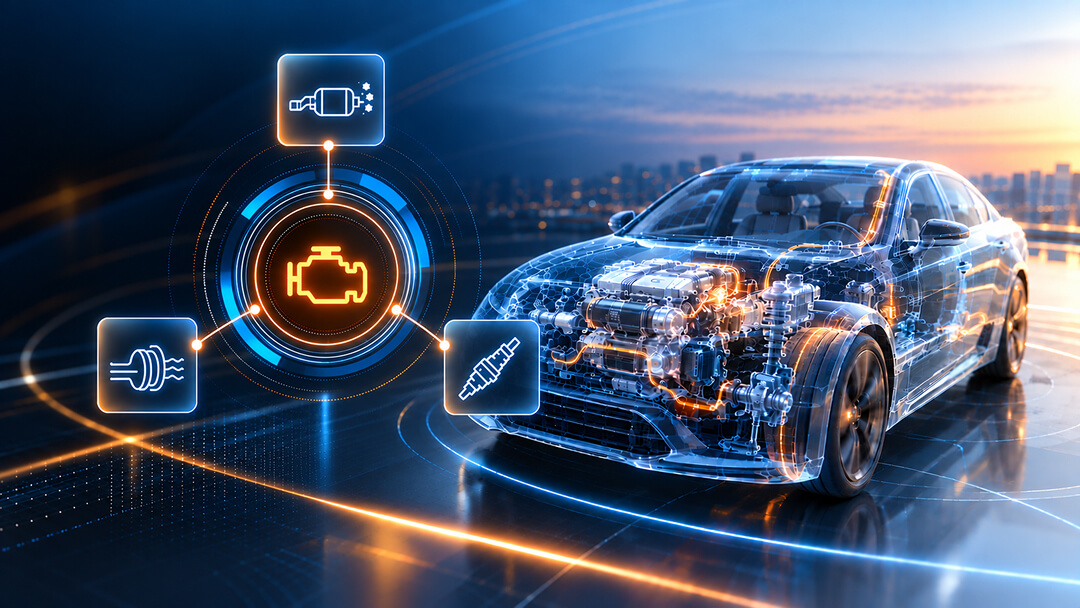
When your check engine light comes on, it doesn’t necessarily mean there’s a problem with the engine itself. The light is part of your vehicle’s on-board diagnostics system, or OBD-II, which monitors the engine, transmission and emissions-control components for problems. When the system detects an issue, it stores a diagnostic trouble code (DTC) and turns on the check engine light to let you know something needs attention.
What does the check engine light actually monitor?
The check engine light is officially known as the Malfunction Indicator Lamp (MIL). It is connected to your vehicle’s on-board computer, which constantly monitors information from the engine, transmission and emissions-control systems for problems that could affect vehicle performance or emissions. It can detect issues involving components such as oxygen sensors, mass air flow sensors, ignition coils, spark plugs and catalytic converters.
When a problem is detected, the vehicle’s computer stores a diagnostic trouble code. That information can be accessed through the OBD-II diagnostic port, typically located under the dashboard, using a compatible scan tool.
All 1996 and newer cars and light trucks sold in the U.S. are equipped with OBD-II technology. When you start your vehicle, the check engine light should briefly illuminate as part of a system check and then turn off if no problem is detected.
What should I do if my check engine light comes on?
If the light comes on and stays on while you’re driving, don’t panic, but don’t ignore it. The cause could range from a relatively simple issue, such as a loose or missing gas cap, to a problem that could become more expensive if left unaddressed.
Start by paying attention to how your vehicle is running. If there are no other obvious problems, check the gas cap and make sure it is tightened properly. If the gas cap was the cause, the light may not turn off immediately. It can take a few trips for the vehicle’s computer to confirm that the issue has been resolved.
If your check engine light is flashing rather than staying steadily illuminated, treat it more urgently. A flashing light can indicate a serious problem, such as an engine misfire, that should be addressed promptly. Learn more in our related article: What Does a Flashing Check Engine Light Mean?
Where can I get my check engine light checked for free?
One of the easiest ways to begin diagnosing a check engine light is to get a free scan at a participating auto parts store. Many retailers offer free warning-light scans that read the diagnostic trouble code stored in your vehicle and provide a basic report.
A free code scan is a useful starting point, but identifying a trouble code is not necessarily the same thing as fully diagnosing the cause of the problem. The next questions are often: What does the code mean? How serious is the problem? What should it cost to fix? And what should I do next?
How CarMD Connect can help
That’s where CarMD comes in. Since 2006, CarMD has helped drivers better understand check engine light issues. The free CarMD Connect app helps you move from a dashboard warning to useful information and next steps.
You can use AskCarMD, the app’s AI Auto Expert, to ask questions about dashboard warning lights and vehicle problems 24/7. If you receive a compatible diagnostic report, scan its QR code in CarMD Connect to get additional information about the problem, including repair guidance and cost information.
Check engine lights can be annoying and sometimes intimidating, but the light is designed to give you an early warning. Finding out what triggered it and understanding what to do next can help you make a more informed repair decision and potentially prevent a smaller problem from becoming a more expensive one.